Drone Survey Company
Thermal and Moisture Survey
Radiometric thermal imaging from the air, read against the conditions on the day, for heat loss, trapped moisture and hard to trace damp.
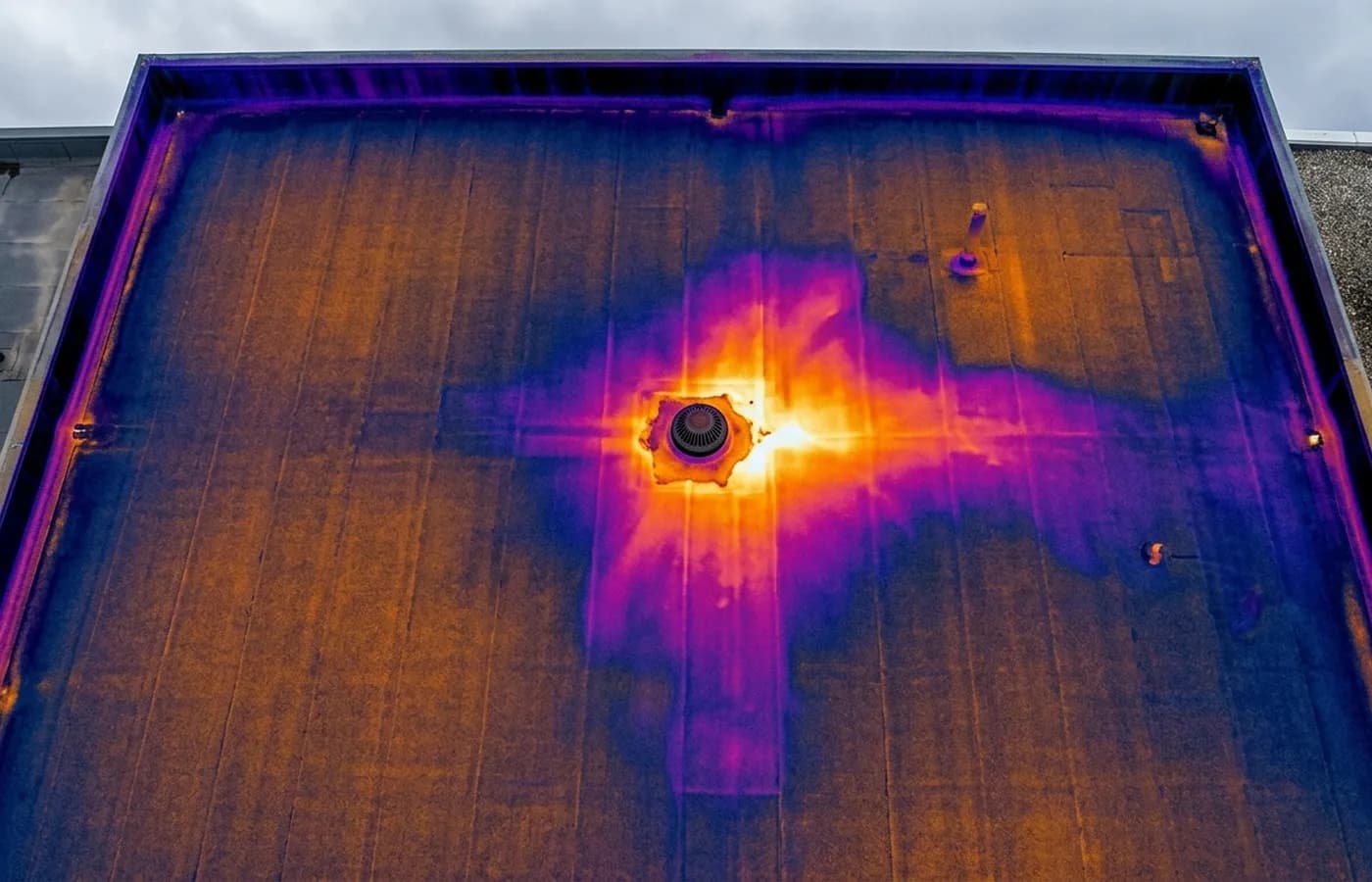
The second aircraft carries a 640 by 512 radiometric thermal camera, which reads temperature rather than colour. Used properly it finds things a visual survey cannot: water sitting inside a flat roof build up, a run of missing insulation across a ceiling line, a warm patch spreading from a failed detail.
Used badly it produces a striking orange picture that means nothing. Thermal imaging depends entirely on the conditions: a dry surface, a real temperature difference between inside and out, no sun sitting on the roof warming it unevenly, and a material that behaves the way you think it does. A firm that offers thermal work without mentioning any of that is selling the picture rather than the reading.
So this service is booked around the weather rather than the diary, and the report says what the conditions were and how far the reading can be trusted.
What is included
- Radiometric thermal imagery of the roof or elevation in question
- The matching visual imagery of the same areas, so a reading can be placed
- A record of the conditions at the time of the flight
- A written reading of what the anomalies suggest and what they do not prove
- A plain statement of anything the conditions made unreadable
- Written report inside 48 hours with the full resolution imagery
Flat roofs and trapped water
A wet insulation board holds heat differently to a dry one, so on the right evening the shape of a wet area shows through a membrane that looks perfectly sound in daylight. On commercial flat roofs this is the single most useful thing the thermal camera does, because the alternative is cutting cores at intervals and hoping one lands in the wet part.
It has limits worth knowing. A roof that has been rained on that afternoon reads as wet all over. A roof in full sun reads as hot where the sun has been rather than where the water is. A ballasted or heavily gravelled roof hides most of the signal. Where the conditions are wrong, the sensible answer is to come back, and that is what gets said.
Heat loss and insulation gaps
From the air, a thermal pass across a roof on a cold morning shows where warmth is leaving the building: a missed run of loft insulation, a gap where the insulation stops short at the eaves, a warm line along a poorly detailed abutment, a rooflight losing far more than the roof around it.
That is useful for a landlord improving a rating, a homeowner working out where money should go first, and an agent explaining to a tenant why one room is colder than the rest. It is a survey of where the heat is going, not a calculation of what it costs, and the report is careful about that difference.
On the day
How a thermal work runs
- Step 1
Establish what you are actually chasing
Trapped moisture, heat loss and a live leak are three different jobs with three different best conditions. Ten minutes on the phone at the start saves a wasted flight.
- Step 2
Pick the window
Thermal work wants a dry surface and a genuine temperature difference, which in practice usually means early morning after a cold clear night, or evening once the sun is off the roof. The date is set around that.
- Step 3
Fly visual and thermal together
Both cameras over the same areas, so every thermal frame has a matching visual frame. A thermal image on its own is very hard for anyone else to place on a building.
- Step 4
Read it against the conditions
The reading is made with the weather, the material and the time of day in front of it, and the report states them so the next reader can judge it for themselves.
Behind the work
Kit, cover and qualifications
CAA registered
Registered with the Civil Aviation Authority as an operator, with an Operator ID and a Flyer ID held. Ask for the numbers and you will get them before the visit.
A2 Certificate of Competency
The pilot holds an A2 CofC, the certificate that allows flying closer to uninvolved people than the default. There is no GVC, and this site says so rather than leaving you to guess.
Insured with Coverdrone
Commercial operations are insured with Coverdrone. If your site or your managing agent needs a certificate on file, it goes over with the quote rather than after the flight.
Two aircraft, one pilot
A DJI Mavic 4 Pro with a 100 megapixel Hasselblad camera for detail, and a DJI Mavic 2 Enterprise Advanced with a 640 by 512 radiometric thermal camera. Sam Hembury flies both himself.
Thermal work
Thermal and Moisture Survey questions
- Can you fly thermal at any time of year?
- Heat loss work needs a real temperature difference between inside and out, so it is far better in the colder months. Moisture work is less seasonal but still wants a dry surface and no sun on the roof. Summer thermal is possible but the useful window is narrow.
- Does a warm patch prove there is water there?
- No. It shows a thermal anomaly, which is a strong pointer and a good place to investigate. Confirming water usually means a moisture meter, a core, or lifting a section. The report says which of those the finding calls for rather than treating the image as the answer.
- Can you do thermal and a normal survey in one visit?
- Often yes, if the conditions suit both. The visual survey is easier to schedule than the thermal one, so where they clash the thermal window sets the date and the visual work fits around it.
- Do you provide the raw radiometric files?
- Yes, on request, if you have someone who will analyse them separately. Most clients want the reading rather than the raw data, so it is not included by default.
Where
Thermal and Moisture Survey across the South West
Also on this site
See how a job runs
Request a quote with Drone Survey Company
Tell us the address and what you need looking at. Sam Hembury will come back with a fixed price and the next available slot.